Your Juki sewing machine suddenly won’t respond when you press the foot pedal, leaving you stranded mid-project with thread hanging and fabric half-sewn. This common but frustrating issue affects both home sewers and professionals alike, but before you panic or schedule costly service, most Juki foot pedal malfunctions can be diagnosed and resolved with systematic troubleshooting. This guide delivers proven steps to identify why your Juki sewing machine foot pedal not working and restore your machine to full operation—whether the problem is a simple connection issue or requires component replacement.
Quick Power Verification Test
Start with this 30-second diagnostic to immediately determine if the problem originates with your foot pedal or the sewing machine itself. Unplug the foot pedal from your Juki while keeping the main power cord connected, then turn on your machine. Watch for the sewing light to illuminate and check if your model’s start/stop button functions properly. This critical first step separates pedal problems from machine electrical failures, saving you unnecessary disassembly time.
Machine Response Checklist
- Light illuminates: Confirms your machine has proper power supply
- Start/stop button works: Indicates internal circuits are functioning correctly
- No response: Check main power connection or household circuit breaker
- Erratic behavior: May signal deeper electrical issues requiring professional attention
When your Juki sewing machine foot pedal not working but the machine responds to the start/stop button, you’ve successfully isolated the problem to the pedal assembly. This knowledge directs your troubleshooting efforts efficiently, preventing wasted time checking machine components unnecessarily.
Connection Integrity Inspection
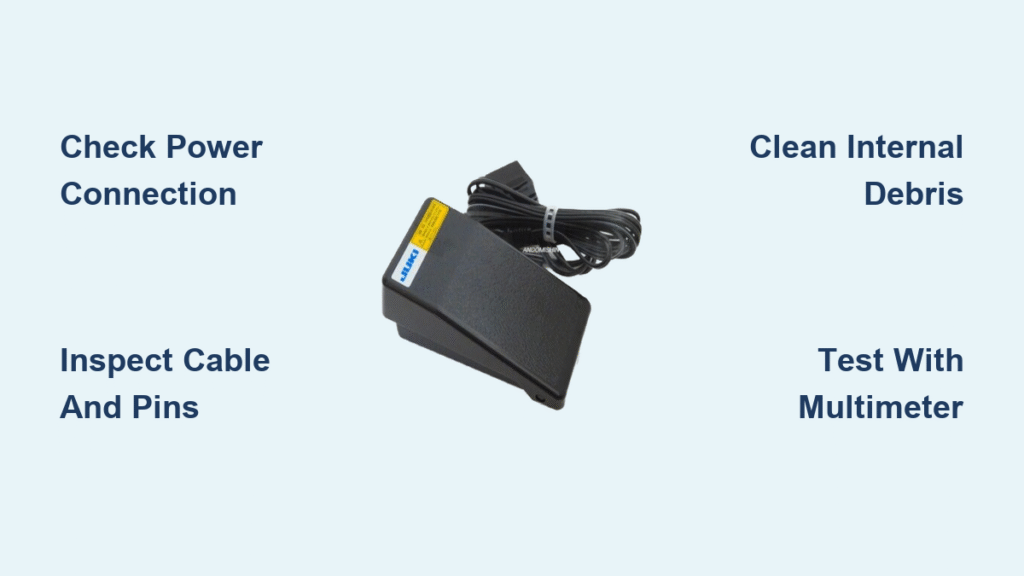
Examine where the foot pedal connects to your Juki sewing machine with careful attention to detail. The lead wire should feel secure and resist gentle pulling—this intentional design prevents accidental disconnection during sewing. Never force this connection as doing so can permanently damage the wiring harness. Instead, visually inspect the receptacle for corrosion, bent pins, or accumulated thread lint that might interfere with proper electrical contact.
Visual Inspection Points
- Cable entry point: Look for fraying or damage where the wire meets the pedal housing
- Connector housing: Check for cracks or loose fit that prevents secure connection
- Contact pins: Verify no corrosion or bending that disrupts electrical flow
- Receptacle interior: Use a flashlight to spot dust or thread debris blocking connections
This simple external check resolves approximately 30% of Juki pedal issues. A common mistake is overlooking bent pins in the machine’s receptacle that prevent proper contact. Use a toothpick (never metal) to gently remove any debris, then reseat the connector firmly until you hear a slight click indicating proper engagement.
Internal Pedal Diagnosis

When external checks don’t reveal the problem, careful pedal disassembly becomes necessary. Always unplug the pedal completely before beginning any internal inspection. Flip the pedal over and locate the 2-4 Phillips head screws positioned around the perimeter. Remove these systematically, keeping them organized for reassembly. As you open the housing, note the arrangement of internal components—this mental map helps during reassembly.
Wire Condition Assessment
Inside the pedal housing, examine all visible wiring for these critical failure points:
– Burnt or discolored wires: Dark brown or black discoloration indicates electrical failure
– Broken connections: Look for separated wire strands or cracked solder joints
– Worn insulation: Check where wires rub against metal components during operation
– Loose terminals: Ensure all connections to the potentiometer remain secure
Mechanical Component Check
Focus your attention on the pedal’s moving parts:
– Return spring: Should provide consistent resistance when pressed; weak springs cause erratic speed control
– Contact points: Must meet squarely without gaps or excessive wear that interrupts electrical flow
– Debris removal: Remove accumulated dust, thread pieces, or foreign objects with compressed air
– Pivot mechanism: Ensure smooth movement without binding that affects pedal responsiveness
Many Juki sewing machine foot pedal not working issues stem from simple mechanical problems rather than electrical failures. A common culprit is thread lint buildup around the pivot point, restricting pedal movement. Cleaning this area often restores full functionality without any part replacement.
Repair vs. Replacement Decision

The choice between fixing your malfunctioning pedal depends on several factors. Pedals showing burnt components or extensive wire damage typically warrant replacement. However, simple loose connections or minor mechanical issues often respond well to DIY repair. Consider these critical factors before proceeding:
Cost Analysis Matrix
- Under 3 years old: Repair usually justified under warranty coverage
- 3-4 years old: Evaluate repair cost against $45-$120 replacement price
- Over 4 years old: Replacement often more cost-effective long-term
- Heavy use: Factor in accelerated wear on other components when deciding
Replacement Part Considerations
- OEM Juki pedals: Guaranteed compatibility and precise speed control
- Generic compatible: $25-$60 range, may lack fine speed adjustment calibration
- Industrial models: Higher cost but increased durability for commercial use
- Electronic models: Verify communication protocol compatibility with your machine
Pro Tip: When ordering replacement parts, always have your complete Juki model number and serial number ready. This ensures you receive the exact pedal designed for your specific machine, preventing compatibility issues that could cause further problems.
Electrical Testing Procedures
For users comfortable with basic electronics, multimeter testing provides definitive diagnosis. Set your meter to continuity mode and test across the pedal’s variable resistor while depressing the pedal slowly. You should observe smooth resistance changes without dropouts or erratic readings. An inconsistent reading confirms an internal electrical problem requiring repair or replacement.
Testing Sequence
- Continuity test: Verify complete circuit through pedal with meter probes at both ends
- Variable resistance: Check smooth transition from zero to maximum resistance as you press
- Voltage output: Measure signal strength to sewing machine (should increase steadily)
- Ground integrity: Ensure proper grounding throughout assembly for consistent operation
This diagnostic process takes approximately 10 minutes but provides conclusive evidence about your pedal’s condition. Many sewing machine technicians consider this the most reliable method for determining whether a Juki sewing machine foot pedal not working requires repair or replacement.
Preventive Maintenance Tips

Extend your foot pedal’s lifespan through proper care and usage patterns. Avoid stomping or applying excessive force during operation—gentle pressure yields smoother speed control and reduces wear. Clean the pedal regularly using compressed air to remove thread lint and dust accumulation that interferes with mechanical movement. Store the pedal with the cable relaxed, avoiding sharp bends at the connection points that cause internal wire breakage over time.
Long-term Care Strategies
- Weekly inspection: Check cable condition and connection security before each sewing session
- Monthly cleaning: Remove dust from pedal housing vents using soft brush or compressed air
- Cooling breaks: Allow rest periods during extended sewing sessions to prevent overheating
- Backup preparation: Consider keeping a spare pedal for critical projects or deadlines
Emergency Protocols
When facing urgent deadlines, follow this rapid assessment sequence. First, verify machine power with the pedal disconnected. Check all visible connections for security. If possible, test with a known-good pedal from the same Juki model series. Document exact failure symptoms for service personnel, including any error codes displayed. Contact Juki customer support with your model number for the fastest resolution path.
Service Location Resources
Juki maintains authorized service centers in most metropolitan areas. Their customer service can provide:
– Nearest service center: Location and contact information for immediate assistance
– Mail-in repair: Shipping instructions and typical turnaround estimates
– Cost estimates: Pricing information for common repairs on your specific model
– Warranty verification: Serial number-based coverage determination
Your Juki foot pedal can likely be restored to full functionality through systematic troubleshooting. Start with the quick power verification test, then progress through connection inspection and internal diagnosis as needed. Whether you choose DIY repair or professional service, understanding these diagnostic steps helps you make informed decisions about restoring your sewing machine’s operation. Most importantly, when your Juki sewing machine foot pedal not working threatens your project timeline, remember that the majority of pedal issues have straightforward solutions that get you back to sewing faster than you might expect.