Your Husqvarna sewing machine sits silent despite pressing the foot pedal—a frustrating moment that stops every project cold. Whether you’re piecing a quilt or hemming pants, a dead foot pedal brings everything to a halt. The good news? Most pedal failures follow predictable patterns, and many fixes take under 10 minutes.
When your Husqvarna sewing machine foot pedal not working scenario strikes, resist the urge to replace parts blindly. Over 60% of “dead pedal” cases stem from simple connection issues or cord damage—not internal failures. This guide walks you through proven diagnostic steps that separate pedal problems from machine issues, saving you from unnecessary repairs or expensive technician visits. You’ll know within 20 minutes whether you’re facing a $5 cord fix or need professional service.
Why Your Husqvarna Foot Pedal Stopped Working: Symptom Check
Before grabbing tools, decode what your machine is trying to tell you. Pedal completely dead—no motor response even when pressing hard—often means internal pedal failure or wiring breaks. If machine lights stay on but motor won’t start, the pedal might be fine; instead, your main circuit board could be compromised. Intermittent response (works only when wiggling the cord) screams internal wire damage, while sudden total failure typically points to loose plugs or component death.
Critical distinction: If both forward and reverse functions fail simultaneously, the problem is almost certainly pedal-related. But if lights work while the motor stays silent, your Husqvarna’s internal electronics need attention. Never skip this symptom check—it prevents wasted effort replacing good parts.
2-Minute Power-Cycle Fix for Husqvarna Pedal Failure
Start with the fastest solutions that resolve 25% of “dead pedal” cases. Unplug everything—pedal from wall outlet and machine jack—and wait 30 seconds for capacitors to discharge. This resets glitchy connections caused by power surges. Next, re-seat all connections firmly until you feel a solid click at both ends; loose plugs cause nearly one-third of pedal failures. Test your outlet with a lamp or phone charger—countless sewists waste hours on “broken pedals” only to discover dead outlets. Finally, perform the wiggle test: while depressing the pedal, gently flex the cord near both plugs. If the machine sputters to life, you’ve found your culprit: internal wire damage.
Pro Tip: Always unplug by gripping the plug base—not the cord—to prevent strain-relief damage at connection points.
Visual Cord Inspection Guide for Husqvarna Pedals

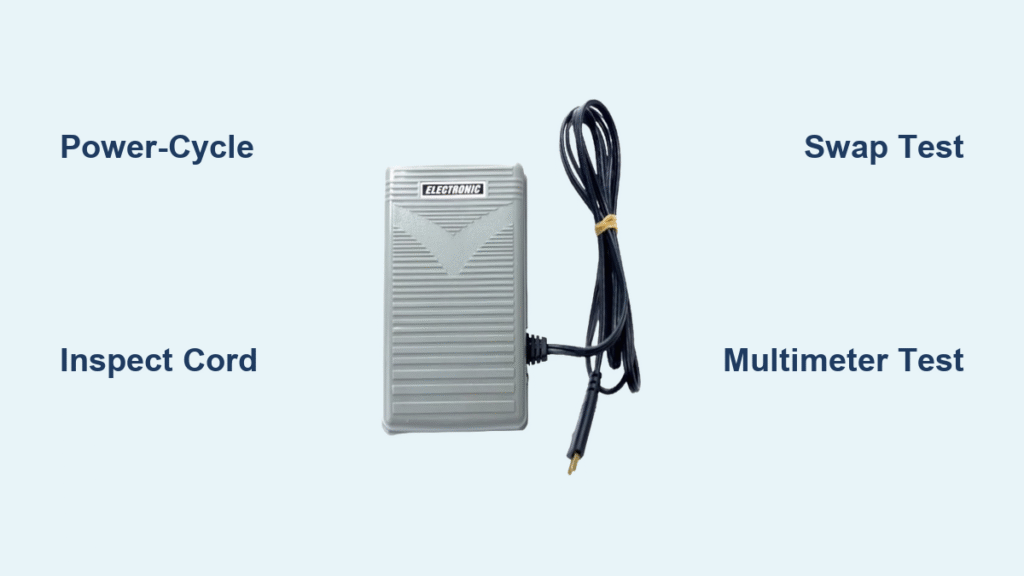
Grab a flashlight and examine every inch of your pedal cord under bright light. Look for these critical red flags:
– Cuts or deep nicks in the outer insulation (common near sewing chairs)
– Permanent kinks that won’t straighten out (indicates broken conductors inside)
– Loose strain-relief where cord meets plugs (wiggles excessively when touched)
– Discolored or melted areas (sign of electrical arcing)
Perform the flex test: Bend the cord gently at each plug end while pressing the pedal. Crackling sounds or intermittent motor response confirm internal breaks. If wiggling the cord temporarily restores function, the fix ranges from re-terminating the plug ($5) to full cord replacement ($20-40). Never ignore early cord damage—small nicks worsen rapidly with pedal movement.
Swap Test: Borrow a Husqvarna-Compatible Pedal

Compatible pedals for testing:
– Any Husqvarna Viking Activa series pedal
– Artista range foot controls
– Some Designer series models
Testing procedure:
1. Unplug your original pedal completely
2. Connect the loaner pedal firmly
3. Press gently—machine should respond normally within 1 second
What results mean:
– Works with loaner = Your pedal is faulty; replace it
– Still dead = Problem is inside your machine (likely main circuit board)
Critical Warning: Avoid Singer or Pfaff pedals—they have incompatible plug geometry and wiring. Using them can damage your Husqvarna’s electronics.
Multimeter Testing Made Simple
A $15 multimeter reveals pedal health in 60 seconds. Continuity test (pedal unplugged): Set meter to continuity mode, touch probes to plug prongs, and press pedal fully. No beep = open circuit (replace pedal). Steady beep = wiring intact. For electronic pedals (Activa/Artista), perform a variable resistance test: Resistance should smoothly drop from ~10kΩ (idle) to near 0Ω (fully pressed). Erratic jumps mean a worn carbon track—common after 5+ years of use. If resistance shows infinite (OL) regardless of pedal position, internal components have failed completely.
Pro Tip: Husqvarna’s mechanical pedals (Classica 105/Lena) don’t use variable resistance—they’re simple on/off switches. Test these for clean contact closure only.
Machine Port Inspection When Pedal Tests Good
If your pedal passes multimeter tests but the machine stays silent: Inspect the jack with a flashlight. Look for bent pins, lint blockages, or corrosion inside the port. Use compressed air to blast out debris—accumulated thread dust mimics pedal failure in 15% of cases. Check voltage specifications by calling Husqvarna support (1-800-446-2333) for your model’s wiring diagram. Missing voltages at the jack indicate main circuit board failure. This step requires electronics knowledge—skip it if uncomfortable.
Model-Specific Husqvarna Pedal Fixes
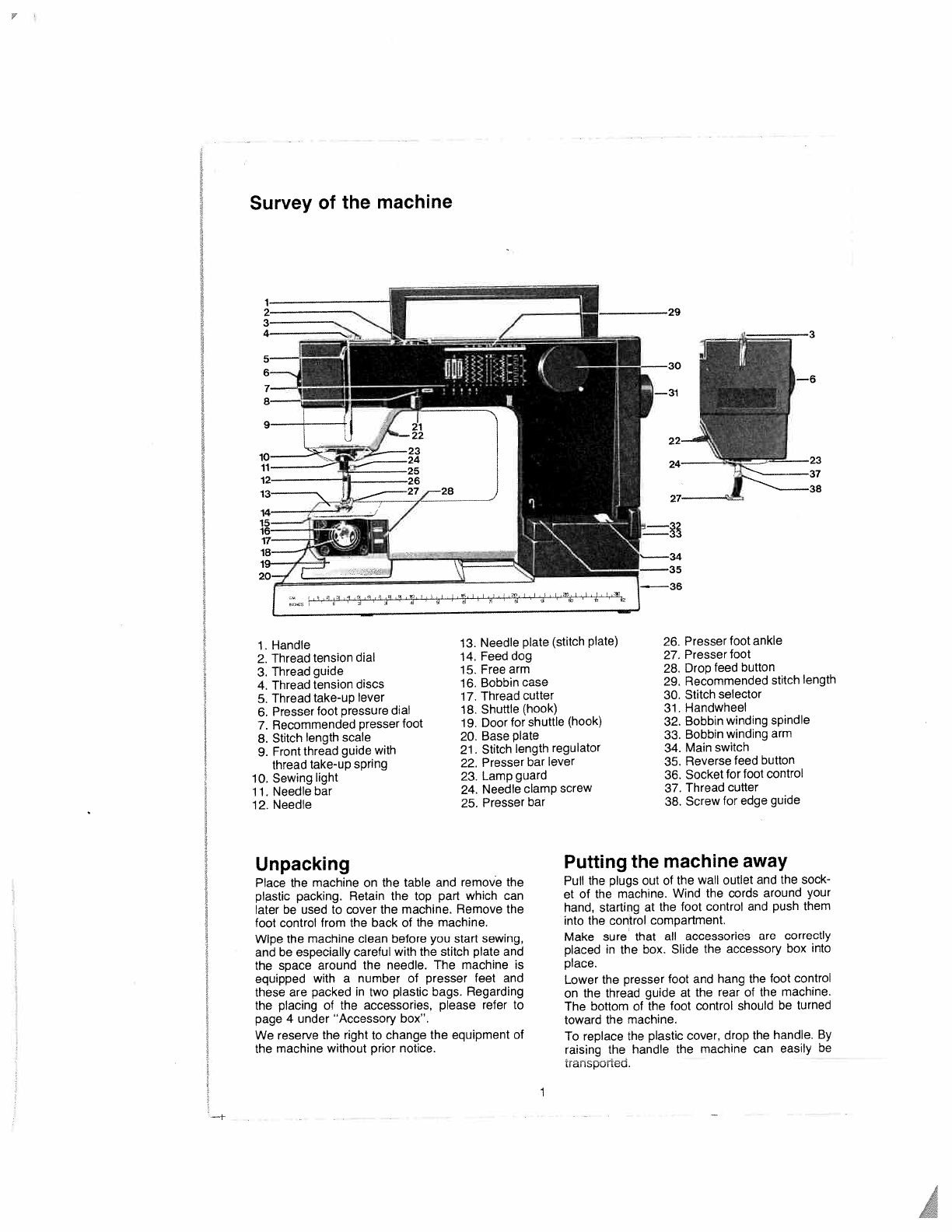
Classica 105 owners: Your 3-pin DIN mechanical pedal rarely fails electronically, but cord breaks are common at strain-relief points. Lena users: Tighten the threaded barrel connector firmly before assuming pedal failure—loose collars cause intermittent operation. Activa/Artista series: Pedals are interchangeable for testing, but internal circuits differ—never swap parts between models. Sew Easy hybrids: Ignore rumors about “needle-position tap” features; pedal failures follow standard electronic patterns.
Critical Note: Lena models require checking serial prefixes (Part #4130276-01)—early runs use different plugs. Verify compatibility before ordering.
Replacement Options Without Breaking the Bank
OEM pedals (guaranteed fit):
– Classica 105: Part #4130267-01 ($89-119)
– Activa/Artista: Part #4130270-45 (electronic, $95-125)
Smart savings:
– Refurbished OEM pedals ($45-65 on eBay)
– Aftermarket compatible pedals ($25-40 on Amazon—only if return policy is 30+ days)
What to avoid: Generic “universal” pedals (often incompatible), Singer pedals (wrong plug geometry), and used pedals without return options. Husqvarna’s 5-year electronic warranty covers pedal failures from normal use—call 1-800-446-2333 before buying replacements.
When to Call a Husqvarna Technician Immediately
Red flags requiring professional help:
– Burning smell from pedal or machine
– Visible damage to machine’s pedal jack
– Lights on but zero motor response (main PCB failure)
– Multiple symptoms beyond pedal response
Cost reality check:
– Bench test: $25-45
– PCB replacement: $150-300
– Labor: $65-95/hour
If your machine is under warranty or shows main board failure symptoms, skip DIY repairs. PCB-level issues require schematic diagrams and hot-air rework stations—beyond most home sewists’ capabilities.
Prevention: 4 Habits to Extend Pedal Life
- Unplug by the base—never yank the cord
- Store pedal away from chair wheels and foot traffic
- Coil cords loosely—never wrap tightly around objects
- Monthly maintenance: Blow compressed air through pedal jack and inspect cord for early wear
During storage breaks, unplug both pedal and machine. Power surges during idle periods degrade electronics faster than regular use.
Final 7-Step Diagnostic Checklist
Work through this sequence before spending money:
1. Power-cycle everything—unplug for 30 seconds (fixes 25% of issues)
2. Inspect cord visually—check for breaks at plug ends
3. Swap test with compatible Husqvarna pedal (Activa/Artista)
4. Multimeter test—confirm continuity/resistance
5. Clean machine port—remove lint with compressed air
6. Test machine voltages—using Husqvarna’s wiring diagram
7. Replace pedal only if testing confirms failure
Your Husqvarna’s foot pedal connects you to decades of precision engineering. With these steps, you’ll diagnose pedal failures accurately 90% of the time—avoiding unnecessary replacements and technician fees. Remember: Most “dead pedal” emergencies stem from preventable cord damage or loose connections. Keep this guide handy, and you’ll conquer the Husqvarna sewing machine foot pedal not working crisis in under 20 minutes.