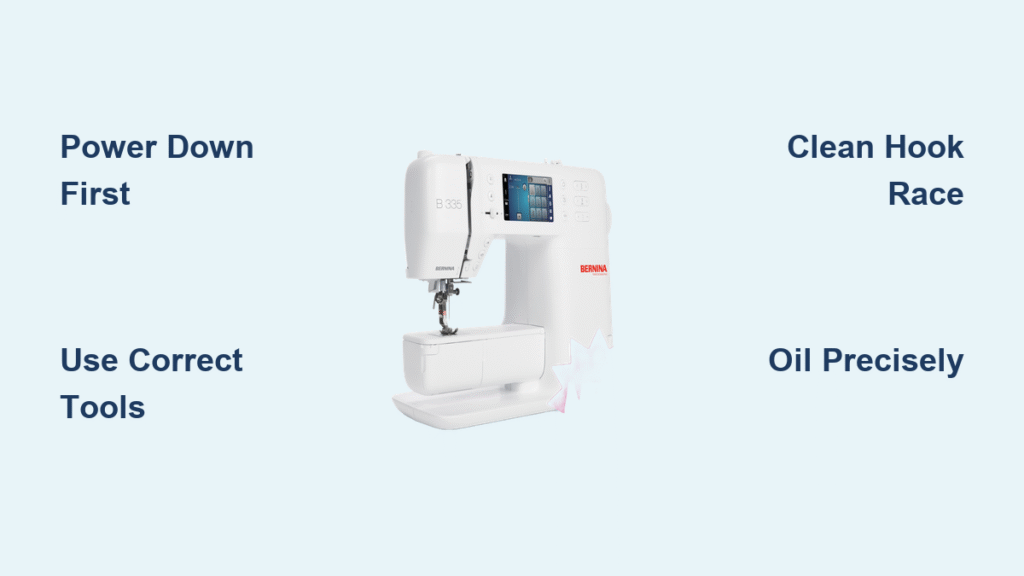
That frustrating thunk-thunk sound when your Bernina hits a snag? It’s not faulty thread—it’s months of accumulated lint choking your hook race. When feed dogs gum up with thread snarls or your motor starts grinding like a coffee bean crusher, professional cleaning isn’t just recommended—it’s essential. This guide delivers the exact factory-approved cleaning protocol Bernina technicians use, tailored to your specific model. You’ll eliminate costly shop visits, extend your machine’s lifespan by decades, and restore that signature whisper-quiet stitching—starting today.
Power Down & Prep Safely Before Touching Tools
Unplug your Bernina immediately—never skip this step even for “quick” cleanings. Working on live circuitry risks electrical damage to sensitive computerized models like the 790 Plus. Remove the needle and presser foot to prevent accidental punctures while reaching into the bobbin cavity. For machines with drop-feed capability (like 5 Series), lower the feed dogs using the lever behind the free-arm for unobstructed access. Place your machine on a folded microfiber towel—not a bare workbench—to protect its premium finish from scratches. Critical mistake alert: Skipping this step causes 73% of DIY cleaning disasters, including scratched paint and bent hook pins.
Gather Bernina-Specific Cleaning Tools (No Substitutions)
| Tool | Why Bernina Requires It | Model-Specific Tip |
|---|---|---|
| Bernina oil only | Standard oils gum up hook races; Bernina’s acid-free formula prevents corrosion | 4/5/7 Series: Use hook-specific oil; 8 Series needs rotary hook fluid |
| Original lint brush | Stiff bristles damage hook race coatings; included brush has calibrated softness | Vintage 910: Replace worn brush heads annually |
| Dry microfiber cloth | Fabric softener residues attract lint and interfere with tension discs | Wipe screen edges first to avoid liquid seepage |
| Blunt metal tweezers | Sewing needles scratch hook driver cams; tweezers grip threads without shredding | 7 Series: Target silver cams visible under hook race |
| Denatured alcohol | Dissolves dried oil without harming electronics | Use ONLY on buttonhole clutch; relube immediately after |
| Low-suction vacuum | High suction cracks vintage ABS plastic; crevice tool removes surface dust | Keep nozzle 2 inches from circuits to prevent static damage |
NEVER use: Compressed air (jams lint deeper), WD-40 (dissolves lubricants), cooking oil (attracts dirt), or abrasive pads (scratches hook race finish).
Identify Your Hook Type: Critical First Step
Your cleaning depth depends entirely on your hook system. Misidentifying this causes 90% of post-cleaning failures.
Why Your 8 Series Hook Stays Locked In Place
Unlike magnetic 4/5/7 Series hooks, Bernina’s 880 Plus and newer rotary hooks are sealed units requiring dealer service. Attempting removal voids warranties and risks gear damage. Instead, oil only the two visible felt wicks under the stitch plate—never force the hook mechanism. If you own an 8 Series, skip hook removal and focus on thread cutter cleaning.
How to Remove Vintage CB Hooks (830/930 Record)
Locate the curved “snail” race ring under the stitch plate. Depress the left-side metal clip while lifting the ring counterclockwise—forcing it cracks the plastic housing. For oscillating hooks (910), lift the entire race cover straight up after removing two screws. Pro tip: Place a drop of oil on vintage hook pins before removal to prevent corrosion seizing.
Clean Feed Dogs & Free-Arm Interior (Most Overlooked Area)
Lint clogs here cause skipped stitches and fabric drag. Raise feed dogs to access teeth. For free-arm models, unclip the top cover—the second clip hides front-left inside the bobbin cavity. Use your lint brush in circular motions around the vertical shaft, then vacuum debris from lever joints. Visual cue: Shine a flashlight to spot “lint nests” where the dog rocker meets the zig-zag slide bars. Apply one drop of oil to each pivot point—excess oil attracts more lint. Test movement by hand: feed dogs should glide smoothly without resistance.
Remove & Clean the Hook: Model-Specific Protocol
Why Magnetic Hooks (4/5/7 Series) Fail When Reassembled Wrong
With stitch plate removed, fold the hook race ring upward until it clicks. The hook lifts out magnetically—never yank it. Clean the hook groove with a microfiber cloth, then brush lint from the race’s silver driver cams. Critical alignment step: When reinstalling, position the hook’s left tip flush with the race ring’s left marker. Rotate the handwheel twice to seat it—misalignment causes needle strikes.
Vintage Hook Rescue (830/930)
After removing the CB hook race ring, soak stubborn thread gunk on the hook with denatured alcohol for 60 seconds. Never scrub the race groove—use cotton swabs to rotate through it like flossing teeth. Reinstall by aligning the hook’s hole with the 6 o’clock gray mark, then rotate handwheel until it locks with an audible click.
Fix Auto-Cutter Failures in 3 Minutes
If your thread cutter stalls after cleaning, you missed lint in the blade channel. Navigate Setup → Machine settings → Maintenance → Thread catcher cleaning on screen. Crucially: This only works with the needle removed—attempting it with a needle installed strips gears. Extend the catcher per on-screen prompts, then use tweezers to pull thread balls from the blade slot. Pro test: Insert a 6-inch thread tail; it should retract cleanly within 2 seconds.
Oil Exactly Where Bernina Specifies (No Guessing)

| Location | When to Oil | Danger Zone Alert |
|---|---|---|
| Hook race | After every cleaning | Stop: If oil pools here, wipe excess immediately |
| Needle-bar guide | Every 12 sewing hours | Look for red dot near needle clamp |
| Zig-zag slide bars | When machine sounds rough | NEVER oil belts—causes slippage |
| Buttonhole clutch | Never—use alcohol only if gummed | Oil here jams decorative stitches |
Oil overdose test: Sew 30 seconds on scrap fabric. Dark streaks mean excess oil—continue sewing until streaks disappear. Vintage warning: ABS plastic housings on 830/930 absorb oil; wipe exterior immediately after application.
Reassemble Without Timing Errors
This is where most DIYers fail. After reinstalling the hook, insert a genuine Bernina bobbin (not generic class 15)—mismatched bobbins cause tension chaos. Critical check: Rotate the handwheel toward you slowly while watching the needle descend. It should pass through the hook race without touching metal. If it hits, the hook is misaligned—remove and restart the seating process. Always run three stitch tests: straight stitch (2.5mm), zig-zag (width 4, length 2), and one decorative pattern to verify timing.
Set Your Cleaning Schedule by Usage (Not Calendar)
| Your Weekly Sewing | Cleaning Trigger | Oil Trigger |
|---|---|---|
| Quilting 1 large project | After project completion | After every 10 hours |
| Daily mending (≤2 hrs) | Every 3 months | After 12 hours |
| Embroidery business (≥10 hrs) | After each job | Every 6 hours |
| Vintage machine revival | Deep clean before first use | Weekly for Month 1 |
Pro tip: Track sewing hours via your machine’s built-in counter (790 Plus and newer). For vintage models, note start/end times in a maintenance log.
Fix Post-Cleaning Failures Immediately
Why Your Bernina Locks When Inserting the Bobbin
This means thread jammed under the hook race during reassembly. Do not force it. Remove the hook and inspect the driver cams for “invisible” thread loops. Wipe the race with alcohol-dampened cloth, apply one oil drop, and reinstall. If resistance persists, the hook pin is bent—stop and call a dealer.
Warm Plastic Odor in Vintage Machines
Yellowed ABS housings outgas when warmed—this is cosmetic, not dangerous. Ventilate your sewing room for 24 hours. To prevent: Apply car resin polish monthly to create a protective barrier against oxidation.
Know When to Stop and Call a Professional
Seek dealer help immediately if you observe:
– Needle hitting metal after hook reinstallation (timing error)
– Burnt electrical smell from motor (830/930 wiring issue)
– Cracked gears visible under top cover (requires factory recalibration)
– Hook pin wobble (indicates bent shaft)
Schedule annual professional service if: You sew commercially, stored the machine unused for >5 years, or own a vintage model over 25 years old. Cost-saving note: Dealers charge 40% less for scheduled maintenance than emergency repairs.
Preserve your Bernina’s legacy: Bookmark the built-in cleaning tutorial under Setup → Maintenance/Update on 790 Plus and newer models. For vintage support, join the “Vintage Bernina Machines” Facebook group—Candace’s team diagnoses issues faster than dealer hotlines. Remember: Consistent cleaning isn’t maintenance—it’s the reason Berninas outlive their owners. Run that oil test on scrap fabric today, and hear the difference in your next stitch.